Instrument control
The development focus is predictable translation of surgeon input into instrument movement. Bench testing would characterise repeatability, response and behaviour across the intended working range.
 Connect with Starion
Our surgical programme starts with the relationship between the surgeon, the instrument and the operating room. We are exploring a surgeon-directed, robotically assisted concept for instrument control, visualisation, console ergonomics and workflow fit.
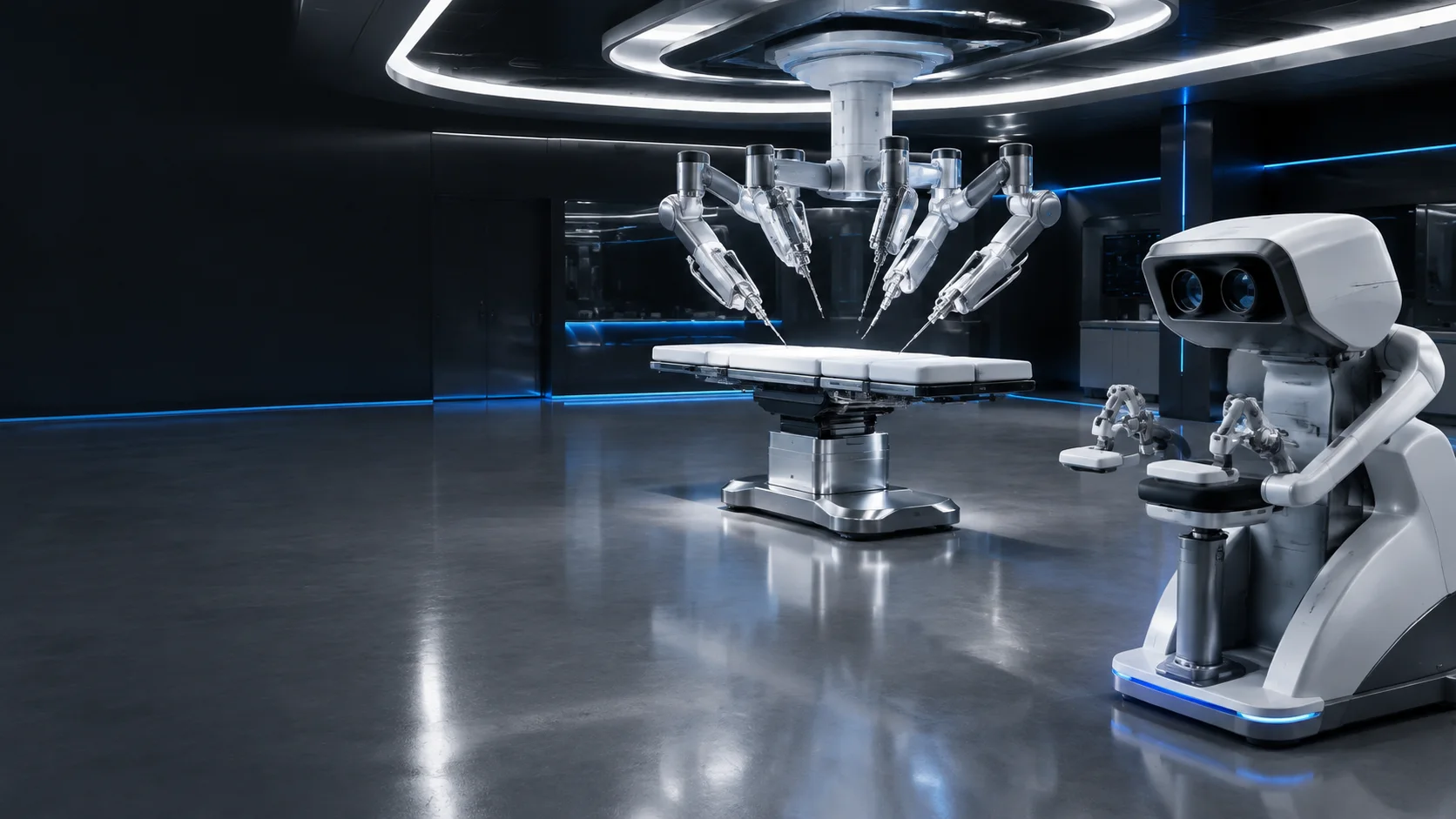
Foreground, right: viewing interface and hand controllers.
Above the table: articulated arms and modular instrument interfaces.
Open floor around an unoccupied table supports a spatial design study.
The development focus is predictable translation of surgeon input into instrument movement. Bench testing would characterise repeatability, response and behaviour across the intended working range.
The concept explores a clear view of the instrument workspace and information that supports surgeon awareness. Visual performance and interface choices require evaluation, not assumption.
Hand-controller position, viewing posture and access to controls are design priorities. Human factors studies would examine comfort, comprehension and sustained use in simulated tasks.
Patient-side access, equipment positioning and routes for the surgical team inform the layout. Simulation would explore setup, repositioning and the space needed around the operating table.
Document the architecture and test methods. Evaluate repeatability and response under controlled conditions. Publish results when available, with the operating conditions, test method and measurement scope beside each figure.
Explore interface usability, supervised tasks and workflow fit in non-clinical environments. Use findings to inform the next design iteration.
Any later clinical evaluation would depend on documented evidence, appropriate oversight and applicable regulatory requirements. No clinical availability or indications are claimed.
For clinical insight, simulation collaboration and technology partnerships.